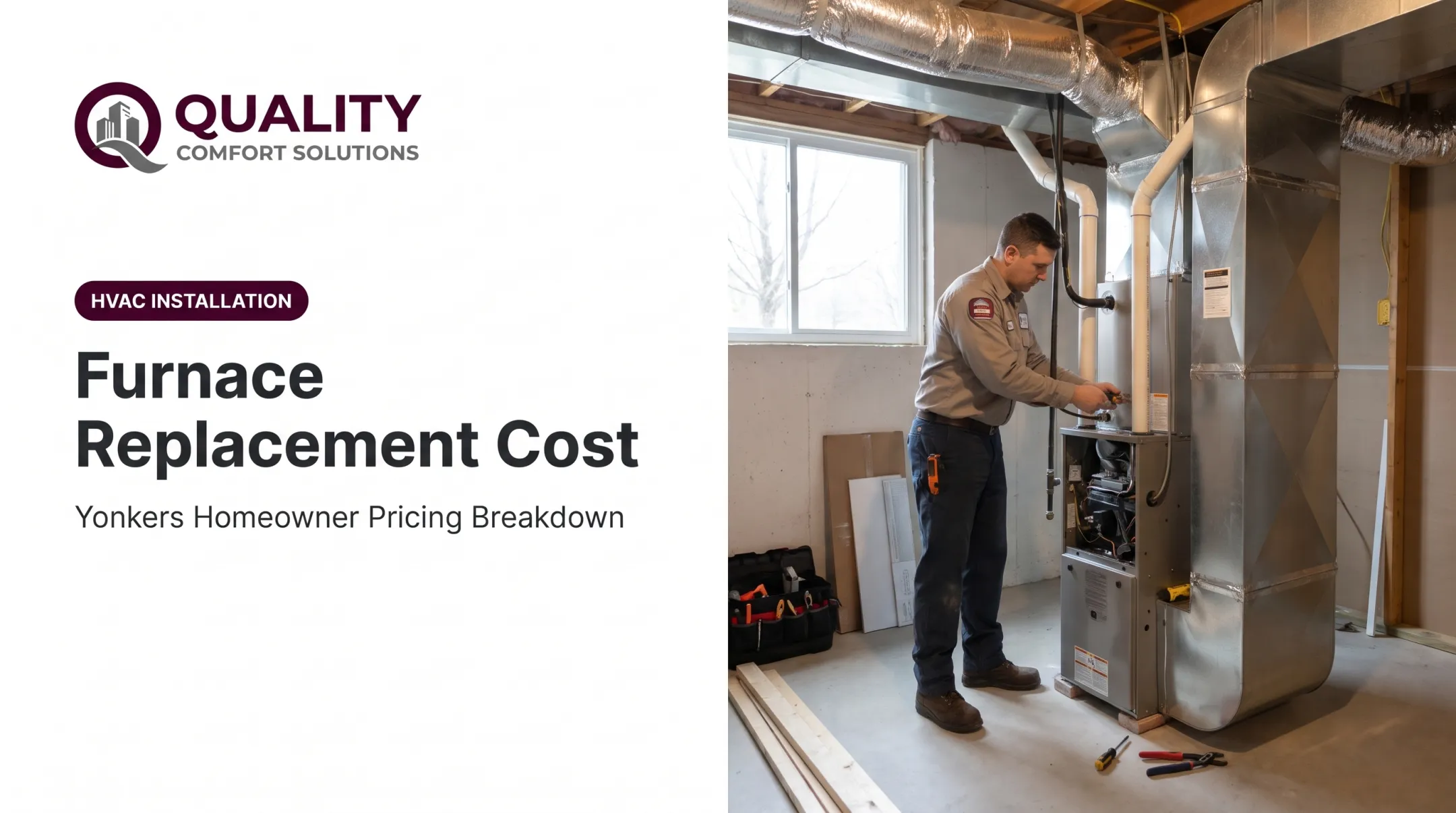
Nationally, Angi's 2026 data puts the average furnace repair at $318, with most jobs landing between $133 and $505. Furnace type, failed part, diagnostics, labor, access, warranty, and after-hours timing all move that number.
This guide covers repair ranges, service-call charges, component costs, hidden line items, and how to decide between repairing and replacing.
Key Takeaways
- Typical U.S. furnace repair runs $133-$505, averaging $318.
- Final price hinges on the failed part, furnace type, access, and emergency timing.
- Sensors and ignitors usually cost less; blower motors and heat exchangers can tip toward replacement.
- Cheapest quote isn't always the best value once safety and repeat repairs count.
How Much Does Furnace Repair Cost? (Pricing Overview)
There's no fixed price for furnace repair. A diagnostic visit might find a clogged filter choking airflow, or a failed motor, control board, gas valve, or cracked heat exchanger.
Misreading the price carries real risk:
- Underbudgeting for parts and labor
- Approving a repair based on a symptom alone
- Overlooking follow-up maintenance or replacement costs
Typical Furnace Repair Cost Range
Angi's 2026 component estimates give a workable picture:
| Repair level | Examples | Published range |
|---|---|---|
| Lower | Flame sensor | $150-$250 |
| Moderate | Ignitor | $150-$500 |
| Moderate | Thermostat | $100-$600 |
| Moderate | Gas valve, circuit board | $200-$600 each |
| Higher | Draft inducer motor | $200-$1,500 |
| Higher | Blower motor | $150-$2,000 |
| Higher | Flue pipe | $400-$800 |

Published pricing for cleaning, fuses, capacitors, and heat-exchanger repair is hard to pin down, so ask your technician for a written figure on those. Heat-exchanger problems often push a homeowner to weigh replacement.
What the Published Ranges Include and Exclude
Angi's average and component figures don't say whether they cover the diagnostic fee, parts, labor, tax, permits, or emergency surcharges. Treat them as planning numbers and budget a cushion.
Angi's general HVAC guide lists a $100-$250 service-call fee, then either a flat repair price or $100-$250 per hour plus parts. That's HVAC-wide, not furnace-only. Whether the fee is credited toward the repair varies by company, so ask before booking.
Common Furnace Repair Costs by Component
Price depends on the part's function, brand compatibility, availability, and installation time. A flame sensor is quick to swap. A blower motor or inducer takes longer and the part costs more.
Symptoms can point you somewhere, but only a professional diagnosis confirms the cause:
- Short cycling: often a dirty filter, overheating that trips the limit switch, or a bad thermostat, according to Carrier's guidance
- Ignition failure: commonly the ignitor or flame sensor
- Weak airflow: filter, blower motor, or ductwork
- Unusual noises: motors, bearings, or loose components
- No heat: thermostat, control board, gas valve, or ignition components
Key Factors That Affect Furnace Repair Cost
Two homeowners with the same symptom can get very different quotes. The equipment, the site, the labor market, and the timing all differ.
Furnace Type and Fuel
Gas, electric, oil, and dual-fuel systems use different components and safety controls, which changes both diagnosis and part pricing. Electric furnaces rely on heating elements, so don't price them with gas-furnace ranges. Heating-element prices vary widely by model, so request a model-specific quote.
Failed Component and Repair Complexity
A filter costs next to nothing; a gas valve or motor combines pricey parts with longer labor. A suspected cracked heat exchanger, combustion problem, venting fault, or gas-control issue is a cost and a safety matter. Trane notes that a heat exchanger crack can let combustion gases, including carbon monoxide, into the home. Have a qualified technician assess it.
Size, Configuration, and Accessibility
Model-specific parts, cabinet design, and tight crawl-space or attic installations add labor time. Home size alone doesn't set a repair price. A 2,000-square-foot home may have any capacity of furnace; the model, condition, and the repair needed are what count.
Labor, Diagnostics, and Local Market
Expect service-call fees of roughly $100-$250 and hourly labor in a similar band. Angi says New York City costs run above average because of cost of living and labor, without publishing a specific figure. Local rates in Yonkers and Westchester can differ from national averages, so get written quotes. Travel distance, parts availability, taxes, and permits can all shift a quote.
Emergency Timing and Seasonal Demand
Nights, weekends, holidays, and storms can add cost. Angi reports an extra $40-$80 per hour for HVAC emergency service outside normal hours. No universal weekend or holiday multiplier exists, so ask what the after-hours rate is.

Warranty, Furnace Age, and Repair History
Manufacturer parts warranties can erase part costs, while labor is often handled separately by the contractor. Carrier, for example, offers registered equipment a 10-year parts-only option or 5-year parts plus 3-year labor, but terms vary by brand and registration. Older furnaces with repeat repairs or discontinued parts tend to cost more out of pocket.
Cost Breakdown of Furnace Repair
A furnace repair invoice usually has several cost categories. Review the full estimate, not just the part price.
- Diagnostic and service call (one-time): covers testing and troubleshooting. Ask if it's applied to the approved repair.
- Parts and consumables (one-time): manufacturer, model, availability, shipping, and compatible alternatives affect this line.
- Labor and access (one-time): hours, minimum charges, removal of surrounding components, and post-repair testing.
- Permits, disposal, additional work (occasional): venting, condensate, electrical, or related HVAC work. Request itemized pricing. Yonkers' gas application is unclear on like-for-like repairs, so confirm permit needs with your contractor.
- Maintenance and future costs (recurring): filters, tune-ups, energy use, and age-related failures aren't on this bill. Carrier estimates tune-ups at $70-$400. Ask what upkeep could prevent another breakdown.
Low-Cost vs High-Cost Furnace Repairs: How to Estimate the Right Budget
Don't treat price as a measure of quality. Compare repairs on upfront cost, complexity, safety, reliability, warranty, and the chance of related failures. A cheap fix on a furnace with several aging parts may just be the first of three visits.
Repair or Replacement: Which Option Fits?
Weigh these factors:
- Furnace age and repair history
- Current efficiency and comfort performance
- Parts availability and safety condition
- How long you plan to stay in the home
Carrier suggests considering replacement when a furnace is over 10 years old or a repair nears 50% of a new unit's value. That's a screening rule from one manufacturer, not a standard, and it doesn't replace a professional evaluation.
On lifespan, NAHB's 2021 report gives 20 years for a gas furnace, and Angi cites 15-20 years for condensing and non-condensing models. Published lifespan figures for oil and electric furnaces are scarce, so ask a technician for a unit-specific estimate. Maintenance, installation quality, climate, and usage can push an individual unit either way.
Budgeting for a 2,000-Square-Foot Home or Full HVAC Replacement
Furnace replacement and whole-HVAC replacement are different projects. Published benchmarks:
| Scope | Benchmark |
|---|---|
| Gas furnace, 1,600-2,000 sq. ft. home | Average about $7,000; typical $3,800-$10,000 |
| New furnace, installed (all types) | $1,600-$10,000; average about $4,799 |
| Furnace plus central AC | About $7,500 average |
| Ductwork replacement | $1,200-$3,500 depending on home size |

These aren't interchangeable, since scope and sources differ. Carrier says projects can exceed $12,000 with extensive venting, ductwork, or electrical work. A 2,000-square-foot home still needs a load calculation (Manual J); square footage alone shouldn't pick furnace capacity.
What Most People Miss
- The part price is only one line. Diagnostics, labor minimums, emergency charges, permits, taxes, and follow-up work add up.
- Repeatedly choosing the cheapest repair costs more if the diagnosis is incomplete or an old furnace has several developing faults.
Ask before approving work:
- What failed, and how was it confirmed?
- What does the quote include?
- Is the part under warranty?
- What's the repair warranty?
- What would make replacement more sensible?
Conclusion
The average furnace repair cost is a planning range, not a quote. The failed component, furnace type, labor, access, timing, warranty, and local market all shape the final amount.
If you're in Yonkers or Westchester County and need help with diagnosis, repair, maintenance, or a repair-versus-replace decision, contact Quality Comfort Solutions. The licensed, insured team (License #WC-38653-H25) offers 24/7 support and upfront pricing.
Frequently Asked Questions
What is the average cost to repair a furnace?
Angi's 2026 project data shows an average of $318, with a typical range of $133-$505. The failed part and labor determine your final quote.
How much is a service call on a furnace?
General HVAC service calls run about $100-$250, covering testing and troubleshooting. Some companies credit it toward the repair; confirm that policy before booking.
How much does it cost to fix a short cycling furnace?
It depends on the cause: a dirty filter, thermostat, or limit switch issue. Prices vary widely by the underlying problem, so a diagnosis sets the cost.
How much does it cost to replace a heating element?
This applies to electric furnaces only. Cost depends on the element, model compatibility, labor, and diagnostic fee. Have the failed component verified first and get a model-specific quote.
Should a 25 year old furnace be replaced?
It deserves a replacement evaluation. Weigh safety, repair history, efficiency, parts availability, and comfort against the cost of a new system. No fixed age cutoff exists.
What is the average lifespan of a furnace?
Gas furnaces last roughly 15-20 years, per NAHB and Angi. Installation quality, maintenance, usage, and timely repairs can shorten or extend that.